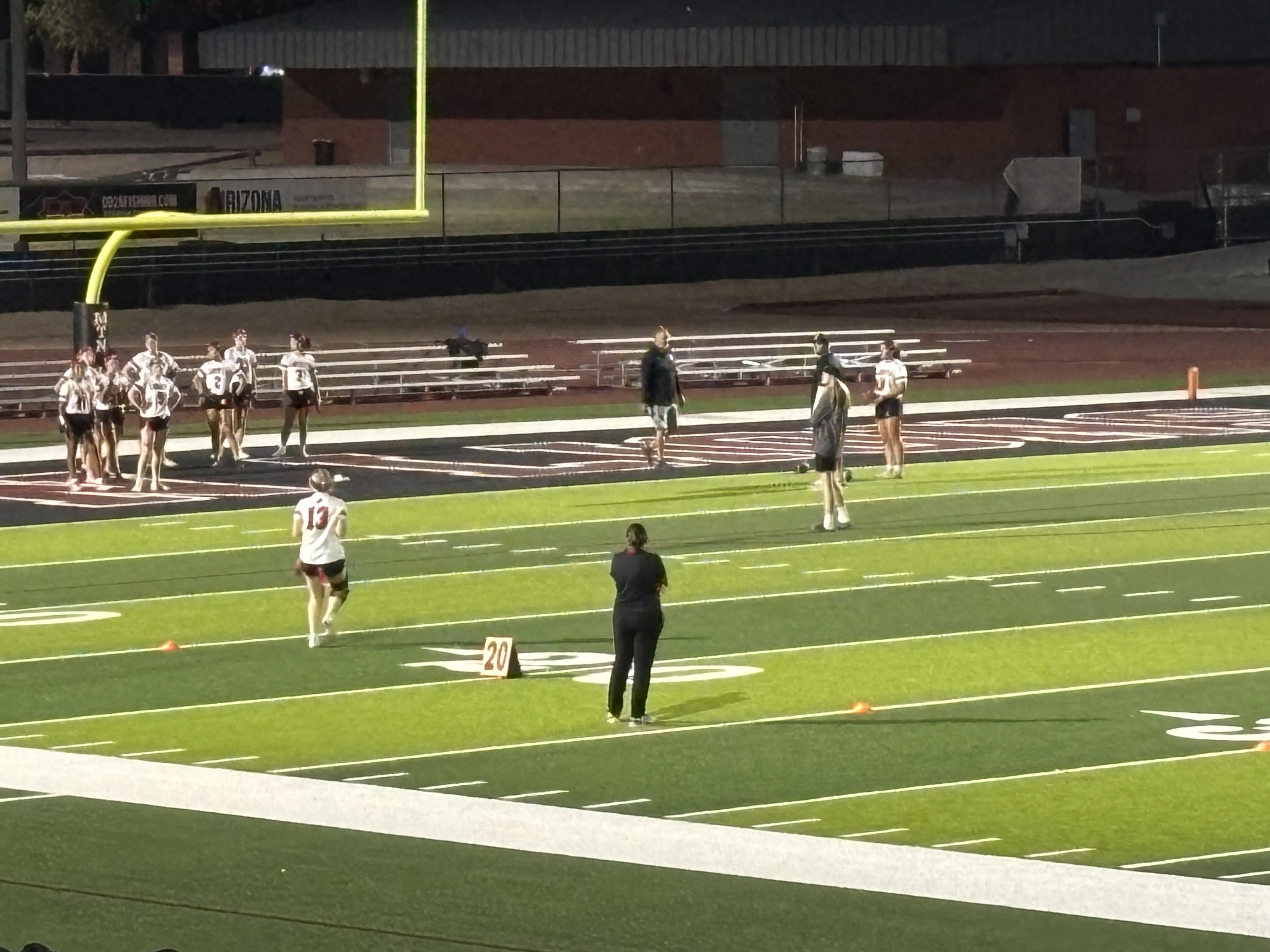
Liberty flag football lays foundation in first AIA season
December 13, 2025 by Cal Searock, Arizona State University
Cal Searock is an ASU Cronkite School of Journalism student assigned to cover Liberty High School for AZPreps365.com.
When Liberty High School stepped into its first AIA season of girls’ flag football this fall, the program faced a challenge far larger than simply learning opponents or managing a new schedule.
For the Lions, the season represented both an effort to compete and legitimize a new sport on campus, and to build a long-term foundation in a league experiencing rapid, statewide growth.
Before joining the AIA, Liberty competed for two seasons as a district club team. The transition to a sanctioned league introduced a new level of structure and expectations. The Lions spent the year adjusting to an official rulebook, a playoff qualification system, and a competitive field of established programs. Much of the roster was made up of freshmen – many who were playing the sport for the first time. That inexperience shaped the program’s priorities but did not diminish the progress Liberty made.
“Our program was very young but showed tremendous growth throughout the season, including big wins over Sandra Day O’Connor at the end of the year and making the playoffs as a top-12 seed,” Liberty Athletic Director Eric Gardner said in a November 25 email.
The broader environment around them was also shifting quickly. Girls’ flag football is one of Arizona’s fastest-growing sports, expanding faster than many athletic departments can support. According to AIA and AZPreps365 data, 54 schools fielded teams in 2023; by 2025, that number had roughly doubled, as districts across the state scrambled to secure coaching staff, equipment, and adequate practice fields.
The AIA constitution designates flag football as a girls-only sport, a classification that shapes how schools organize programs under Title IX and allocate resources. According to Article 14.11.2 of the AIA Constitution and Bylaws, flag football is among the sports “offered for girls only” to address participation gaps. As interest in the sport grew, the AIA refined scheduling and postseason requirements. Under the AIA’s 2025-26 flag football policy manual, schools must play a minimum of eight games to qualify for the postseason. Liberty met that standard, though doing so required careful planning around practice time and field space.
Assistant coach John Carioscia said in a November 26 email that securing consistent practice fields became one of the biggest challenges of the year.
“Field space is probably the biggest hurdle,” he said. “With all the fall sports going on, adding another fall sport just jams up field space for practices.”
He said the challenge is unlikely to disappear.
“I am sure this will be an ongoing situation, working with other programs to gain access to the fields,” he said.
Despite those limitations, the coaching staff focused on decisions aimed at long-term stability. Liberty elected to keep a large number of freshmen on varsity, a strategic move to establish continuity for future classes. Without a junior varsity team, younger players were thrust directly into varsity roles, accelerating their learning curve while demanding careful roster management. Under AIA rules, “No player shall participate in more than 13 games during the season, excluding qualifying and postseason tournaments.”
Carioscia said one of the most rewarding aspects of the season was watching the athletes develop.
“The growth of the girls during this season was amazing to be a part of,” he said.
He noted another step for the program came off the field.
He said forming a booster club marked another major area of growth.
The growing pains extended beyond Liberty’s roster. Because girls’ flag football remains an emerging sport, the association continues to update guidelines, enforce new administrative expectations, and revise structural policies as participation increases. For programs just beginning their AIA journey, those evolving rules add another layer of adjustment.
Carioscia said change will remain constant.
“This program will evolve because it has to evolve,” he said. “We will learn new rules as they come. We just have to continue to move forward, no matter what is put in front of us.”
One area the coaching staff hopes to improve next season involves early-season preparation. AIA policy allows teams to hold one preseason interscholastic varsity scrimmage that is treated as a practice and does not count toward the regular-season game limit. Liberty coaches believe better use of that scrimmage will help them evaluate new athletes, refine playcalling, and install schemes before the regular season begins. Last season, the program had limited ability to fully take advantage of that window as it worked to finalize equipment, facilities, and its roster.
Growth extended beyond the field as Liberty worked to introduce the sport to the wider school community. Gardner said in an email that the athletic department purchased all uniforms and team supplies before the season to ensure the athletes had what they needed from day one.
Although the roster was one of the youngest in the conference, the Lions’ late-season results showed measurable development. Wins over Sandra Day O’Connor, an established and competitive program, helped solidify Liberty’s playoff position and showed how much the team had improved from the start of the season. Their playoff run was short-lived, however, with a 17-0 loss in the first round.
For many players, the postseason represented the highest-pressure environment they had been part of in their athletic careers. The experience offered lessons in pacing, game management, and mental composure. It also marked an achievement that the coaching staff did not take lightly: reaching the playoffs in the program’s first official AIA season.
Looking ahead, Liberty expects to make several adjustments and expansions. Carioscia said in an email that the timing of offseason work will be a major priority as the team enters its second year in the league.
“Being able to start the 2026 offseason at the correct time this year will be very beneficial for this team heading into the fall season of 2026,” he said.
The program is also exploring the possibility of adding a junior varsity team, something coaches and administrators view as essential for long-term development. As the sport expands across the Peoria Unified School District and statewide, a JV roster would allow Liberty to build depth, provide younger players with meaningful game experience, and manage participation restrictions more easily.
The booster club created during the inaugural season is expected to play a larger role as demand grows. For emerging sports, booster support often proves critical in covering equipment needs, travel costs, and team-building opportunities that help athletes develop on and off the field. School funding provides the basics for the girls’ flag football team, while a booster club, supported by parents and the community, can pay for extras such as training, equipment, or travel.
By the end of the year, Liberty found itself in a unique position: still learning the intricacies of AIA competition yet already competitive enough to challenge veteran programs. The Lions built a foundation while navigating limited practice facilities, evolving rules, a young roster, and heightened expectations. Even with those obstacles, they finished among the top teams in the region.
Gardner said in an email that the program’s progress reflected its long-term potential.
Carioscia shared similar optimism.
“We just have to continue to move forward, no matter what is put in front of us,” he said.